Stunegart: A Playfully Nostalgic Blackletter for Modern Design
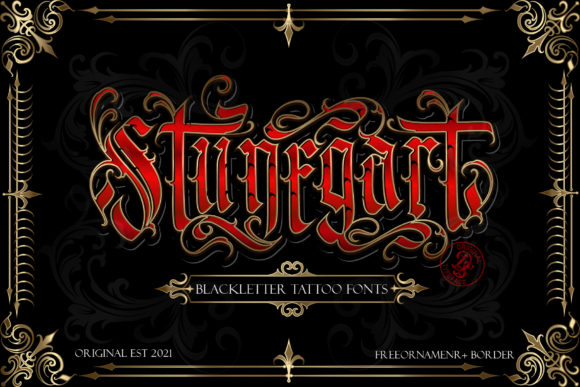
There’s a particular charm in typefaces that carry history. They don’t just spell out words; they evoke a mood, a time, a feeling. Stunegart is one such font. It’s a blackletter display typeface that immediately transports you, not to a medieval scriptorium, but to a warm, analog workshop where craftsmanship and personality are paramount. It feels playfully nostalgic, blending the bold, angular strokes of traditional blackletter with a surprisingly approachable and almost whimsical character. This isn’t the severe, hard-to-read Old English of centuries past. Stunegart delivers an incredible vintage aesthetic that’s been softened and modernized for contemporary use, making it a powerful tool for designers seeking a distinctive, retro touch.
The Visual Soul of Stunegart
At first glance, Stunegart’s DNA is unmistakably blackletter. The letterforms are constructed with a calligraphic sensibility, featuring thick and thin strokes, sharp angles, and intricate, decorative curves. However, its personality diverges from tradition in delightful ways. The overall texture feels less rigid and more organic, as if hand-drawn with a confident, slightly playful hand. The spacing is often more generous than classic blackletter fonts, aiding in a surprising level of readability for a display font. This balance is key to its appeal: it possesses the gravitas and visual weight of a historic style while remaining accessible and full of character for modern logo design, packaging design, and editorial design.
The font’s charm lies in this duality. It can feel heritage and authoritative for a craft brewery or a vintage barbershop, yet simultaneously fun and expressive for a music festival poster or a boutique apparel brand. It’s a creative font that doesn’t take itself too seriously, making it ideal for projects that need to communicate authenticity, individuality, and a touch of handcrafted flair.
Where Stunegart Truly Shines
Understanding a font’s strengths is about matching its voice to your project’s needs. Stunegart isn’t a body text workhorse; it’s a headline hero, a branding cornerstone, and a social media standout.
Branding & Logo Design: This is where Stunegart can build a powerful brand identity. It’s exceptional for logos, wordmarks, and monograms in industries like artisanal food and drink (think craft coffee, specialty spirits, or bakeries), vintage-inspired apparel, record labels, barbershops, tattoo studios, and any brand rooted in heritage or craftsmanship. It instantly communicates a sense of tradition, quality, and uniqueness.
Marketing & Digital Presence: In the crowded digital space, Stunegart cuts through the noise. Use it for hero banners on websites, impactful social media graphics, and video thumbnails. Its high contrast and distinctive shape make it incredibly eye-catching in web design when used for key headings or call-to-action text. Remember, for digital use, pairing it with a clean, legible sans serif font or a simple serif font for body copy is non-negotiable.
Print & Physical Products: The tactile world is where its vintage aesthetic feels most at home. Apply it to packaging labels, merchandise tags, event posters, album covers, book titles, and business cards. The intricate details of Stunegart’s letterforms come alive in high-quality print, adding a premium, artisanal feel to any physical item. It transforms ordinary packaging into a collectible.
Making Stunegart Work For You: Practical Guidance
Adopting a premium font like Stunegart is an investment in your project’s visual language. Here’s how to evaluate and implement it effectively.
Evaluate the Fit: Does your project’s core message align with themes of heritage, craftsmanship, individuality, or vintage appeal? If you’re designing for a law firm or a medical practice, Stunegart is likely the wrong voice. For a distillery, a music blog, or a custom leather goods shop, it could be perfect. The font itself sets an expectation; ensure your brand or project can fulfill it.
Master the Font Pairing: Stunegart demands a thoughtful companion. Because it’s a complex display font, it pairs best with simple, neutral typefaces. A clean geometric sans serif font (like Montserrat or Helvetica Neue) provides a modern, clean counterpoint. A classic, readable serif font (like Garamond or Minion) can create a more traditional, layered hierarchy. Avoid pairing it with other ornate script fonts or handwritten fonts, as this will create visual chaos. Let Stunegart be the star of the show.
Check the Styles & Licensing: Before purchasing, review the font family. Does it include the weights and styles you need (e.g., Regular, Bold, Italic)? Furthermore, scrutinize the commercial font license. Does it cover your intended use—web, print, merchandise? Reputable foundries provide clear licensing terms, ensuring you have the right to use the font across all your design assets without legal ambiguity.
Prioritize Readability: Use Stunegart strategically. It excels in large, short bursts—headlines, logos, pull quotes. Never set a paragraph in it. Test its legibility at the actual size it will be used. Zoom out on your screen or print a proof. If the intricate details blur together, increase the size or choose a simpler word. Its power is in impact, not in conveying dense information.
Ultimately, Stunegart is more than just a typeface; it’s a design catalyst. It invites a specific creative direction, one that values personality and story. By understanding its visual rhythm and applying it with intention, you can harness its nostalgic charm to create designs that are not only beautiful but deeply resonant and memorable. It’s a tool for building brands that feel authentic, projects that tell a story, and visuals that leave a lasting impression.